Where The Linnets Sing
Origins of the Family Tradition
Brigid Tunney, whose maiden name was Gallagher, came from the Border country where counties Donegal and Fermanagh meet. She was born in June 1886, the second child of Michael Gallagher and Mary Meehan, in the townland of Rushen, Pettigoe, County Donegal.
There was a rich singing tradition on her father’s side, her aunts Sarah and Mary being particularly noted. The latter was known as ‘Mary of the Mountain Streams’, because of her beautiful rendition of that wonderful song.
The area, one of loughs and streams, purple heather and golden whin, is even today, somewhat remote, with the result that its heritage of song, dance and storytelling came down to us as a pure and unbroken tradition for at least three generations in the case of the Meehans and three generations on the Gallagher side. Michael Gallagher was a fluent Gaelic speaker; his mother Brigid or Biddy Travers (or Treamhair) came from Eglish up in the Cruacha Gorma, the Bluestack Mountains, above Lough Eske. She later married Paddy Gallagher and moved to Finadoos, outside Donegal Town. Biddy was a teacher and activist in the Tithe War.
I remember Michael Gallagher, who was my maternal grandfather, dandling me on his knee when I was four years of age and attempt to teach me the first verse of The Lark In The Morning:
The lark in the morning she rises off her nest,
She goes up in the air with the dew on her breast.
Like a jolly plough boy she whistles and she sings,
And comes home in the evening with the dew on her wings.
He also had many stories and legends of Greek and Roman heroes, of Fenian warriors and accounts of the notorious ‘Cat Breac’ who had been active in Gaelic speaking districts even in his time. I can well recall the awe and foreboding that filled me when I was taken into the room where he was laid out on a white bed after he died. I couldn’t understand why my music master would not speak to me.
Brigid Tunney (nee Gallagher) learned songs from her mother, her aunt Mary, her grandfather Pat Meehan and from old William Monaghan, who lived on the green hill of Tullaghasson, or Tullyhassen, not far from Rushen. The Meehans and my mother’s aunt Mary lived in Teamhair, or Tamur as it appears on the OS maps, the next townland to Rushen. The womenfolk of that area were expert embroidery workers and many of them could make their children’s clothes. William Monaghan’s wife was one of these. Her name was Susan and before she married, she was hired with Frank Britton, a publican in the village of Pettigoe. William was once heard to remark with a lisp induced by the loss of teeth: ‘It wash a great wonder Frank Britton didn'’ marry her heesshelf – for she – she had handshs on her!’ An expression scarcely less remarkable for its beauty than for its truth.
Then into this remote, mountainy territory, with its linnets and crowing moorcocks, came journeymen tailors, cobblers, weavers and beetle-makers. Some of them came from as far away as Connaught and all of them carried with them songs. On a long winter’s night, when the tailor decided he had stitched for long enough and the ‘spriggers’ or embroiderers resolved to put aside their hoops, an old wheezy melodeon was taken down from the half-loft over the chimney ‘brace’ and the céilí-ers who might be making creels or ‘wrestling the Connaught-man’, a feat almost as impossible to perform as Cú Chulainn’s Cleas an Gha Bholga, joined in the dances executed to the music of the melodeon, that was not at all times the best. Or if there was no melodeon available or no melodeon-player, the music was provided by three lilting women or by the more sophisticated method of music making, played on a comb with some white tissue paper drawn tightly over the teeth. Then a song would be called for, and if Mary Gallagher was among the ‘spriggers’, she sang them The Mountain Streams Where The Moorcocks Crow, As I Roved Out, or Highland Mary or indeed maybe all three of them. On a Sunday night, when house dances were held in the Ring – Pat Meehan’s home – or in ‘Big’ Paddy Gallagher’s, Mary’s father’s residence, ‘Old’ William Monaghan would be an honoured guest and he generally sang in his inimitable style Sheela Nee Iyer, his own special version of The Bonny Bunch Of Roses O! or The Wee Weaver.
Then it was time for another big, wild mountain reel danced generally facing each other with a change of positions at the end of the low part of the tune, executed by both dancers meeting on the ‘clinker’ in the centre of the flag floor, where they shuffled expertly before pivoting into opposite positions. The dancing was done with subtle skill and virtuosity but when a special step like ‘snuffing the candle’ or the well-nigh impossible leg-looping feat known as the ‘screwing step’ the viewers would shout: ‘Fair wind and ripe corn’ or ‘House come out of the window’ which conveyed to the dancers their absolute delight and their deep appreciation of the impossible dancing feats performed.
Brigid Tunney would have been present at many such gatherings but she invariably returned to her aunt Mary ‘to put the silk on her singing’ as the same Mary was wont to say.
My most abiding memory of her was in early July days when corncrakes were giving tongue in the meadow and the first mowers were honing their scythes. ‘Idir speal agus corrán’, mar a deireadh na sean daoine sa Ghaeltacht. She sat in a shaft of sunlight slanting through the west window of the kitchen. The rest of my brothers and sisters were away playing ‘wee houses’ and I stole back. She’d be looking down at the hoops and weaving the most exotic arabesques on the taut cloth with her needle and thread and singing all the while. And such singing! I won’t be likely to hear its likes again.
And that’s how I learned most of her songs. She never realised I was eavesdropping on her singing – trying to steal her gift maybe! But she’d have given them to me anyhow. Or at least most of them.
And that was Brigid Tunney, my mother, the source of so many of the Tunney songs ...The Mountain Streams, The Banks Of Dunmore, Craigie Hill, Lough Erne Shore, Easter Snow, Highland Mary, The Cool Winding Ayr, The Blackbird, Wee Paddy Molloy, The Croppy Boy or Early, Early In The Spring, The Lowlands Of Holland, Erin The Green, The Banks Of The Tweed, The Wee Indian Lass, One Night I Been Tipsy, Lovely Annie, Moorlough Mary, When A Man’s In Love to name but a few. She had no time for simple songs but loved those with the long, melodious line and the difficult air. When I started singing for radio back in the Summer of 1952 and not infrequently sang in traditional programmes written and presented by the late Seán O Boyle from BBC, Belfast, she came up to the city along with me and stayed with one of her daughters while I was singing. All the way up and all the way down, we sang together. On one occasion, I missed my turn off in Portadown and landed in Armagh city instead.
What can I say about myself that has not already been said? I was always passionately fond of music and singing, particularly fiddle playing with a special grá for the fiddle-music of Michael Coleman and Hughie Gillespie. Coleman along with my mother has had the greatest influence on my musical progression. I learned songs from many people along the way, including from my great friends Geordie Hanna, Len Graham, Gerry Hicks, Liam Anderson, Frank Harte and so many more. Singing traditionally has brought me triumphantly through my seventy years to God. May it continue to do so!
Paddy Tunney (ed. John Tunney)
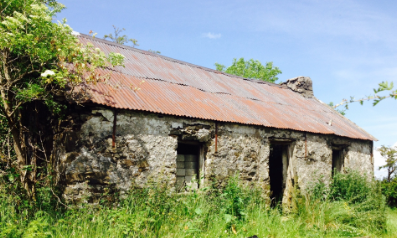
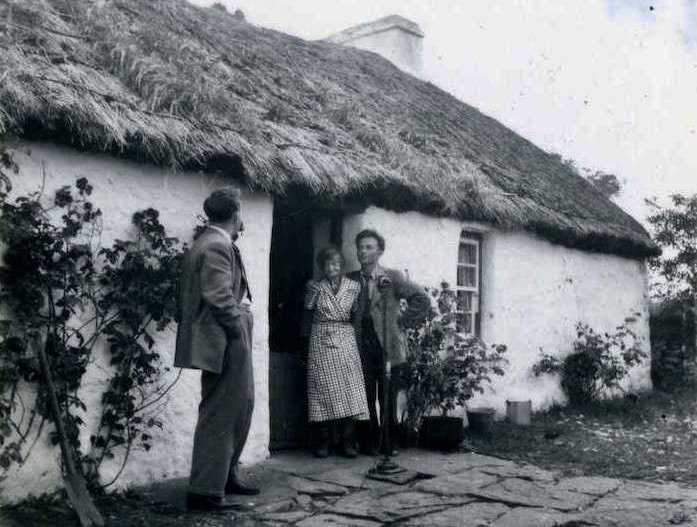
Michael Gallagher’s house on Rushen Hill, Co. Donegal. Singers who were either born or lived in this two-roomed house include: Michael Gallagher, Mary Gallagher (nee Meehan), their children: Brigid, Michael, Minnie and Phelim Gallagher; and Brigid and Patrick Tunney’s children: Maureen, Bridie, Paddy, Phyllis, Joe and Annie.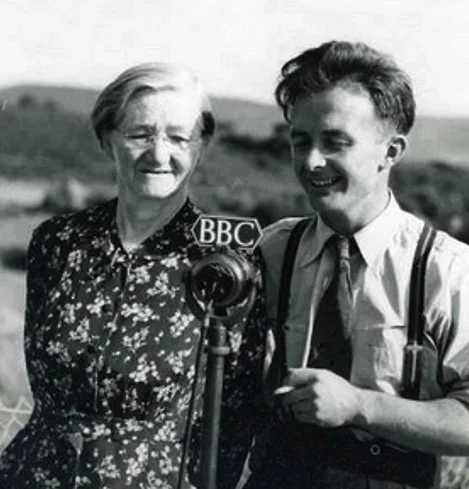
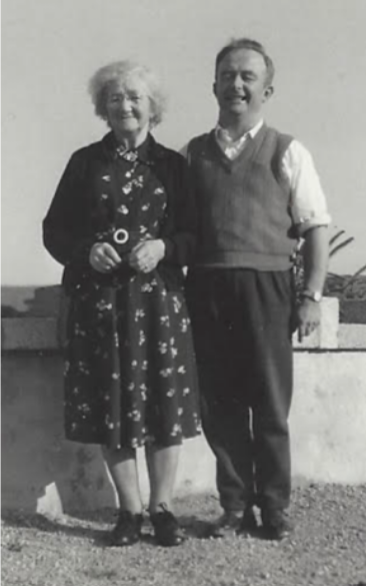
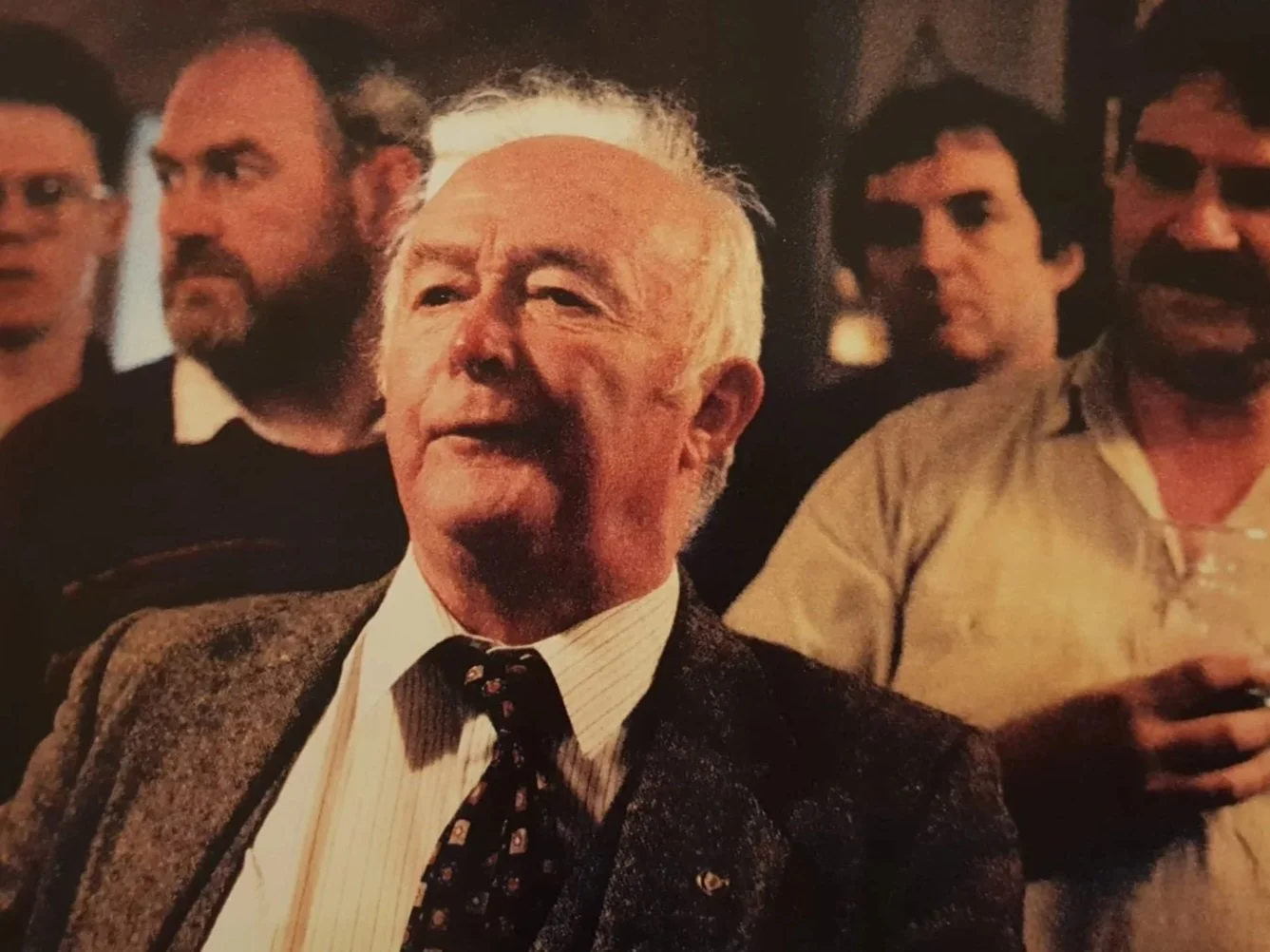
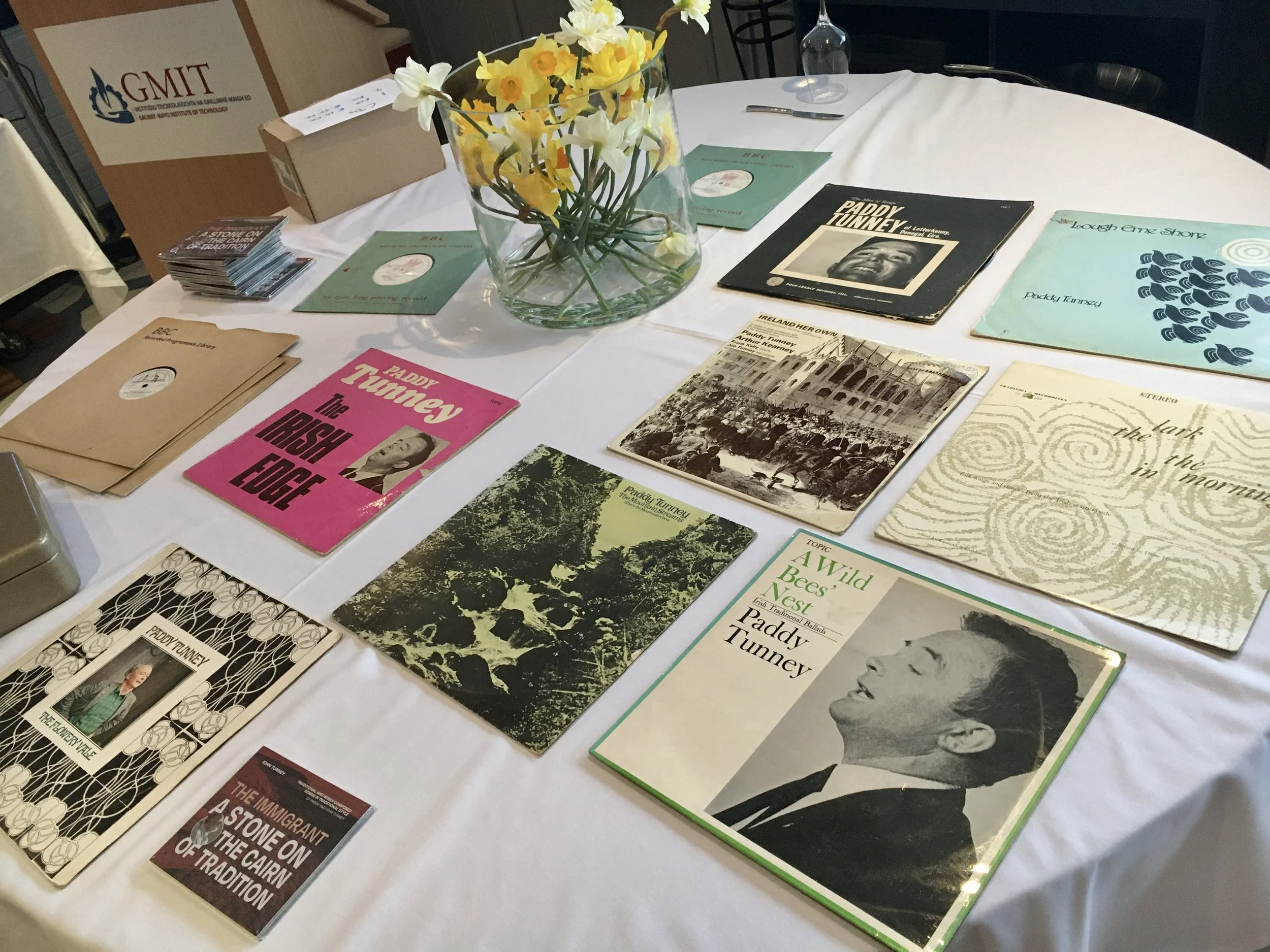
Five Generations of Family Singers
‘And then of course there is the family’, is how Da introduced us on the original WHERE THE LINNETS SING. There are many more family voices to be heard on this 2026 release, nevertheless, let’s start as he did with his own children. There are six of us and we can all be heard both here and on The Stone FiddleProject recordings which the Tunney Song Tradition Trust has done in association with the Irish Traditional Music Archive.
We have been listening to these songs literally since before we can remember. Five years and ten months separates us in age and, as our mother used to tell it, as babbies we were all dandled on Granny Tunney’s knee and rocked to sleep on her breast as she sang us Lough Erne Shore, Easter Snow, Wee Paddy Molloy, The Buachaill Roe and so many more. Our childhoods were filled with songs, singing and singers both in our own home in Letterkenny and in Granny Tunney’s in Fermanagh.
Paddy is the eldest. He sang extensively when he was young and though best known as a fiddler, he has returned to singing in the last decade. He is the promoter of the Letterkenny Traditional Singing Circle, has taken a full part in all the family gigs of the last few years, and made an album-length recording contribution to the Restringing The Stone Fiddle Project.
In 2019, Cathal returned to Ireland and to Donegal after almost forty years living and working in Canada. He was becoming a prominent singer even before he emigrated back in 1981. Indeed, the great Rita Gallagher has said that she first discovered the Tunney singing tradition from Cathal’s singing even before she got to know our father. You can regularly hear him singing at gatherings such as the Inishowen Traditional Singers Circle. Da wrote in the original notes that: ‘He is also a fiddle player. His fiddle sings. Need I say more?’
Brigid is a religious sister of the Congregation of Jesus. She entered the novitiate in 1976 having attended the Fleadh in Buncrana less than two months before. Da wrote of her in this way: ‘Her style of singing is nearer that of her grandmother than any of the others. She listened a lot to the copies of BBC recordings made by my mother in 1952 and 1953 and learned the style more from her granny than she did from me.’ Brigid recorded a beautiful CD, released under the title Hand in Hand, in 2007. It features many classic Tunney songs.
After spells living first in Kerry and then in Leitrim, Michael moved back to Letterkenny in 1996. In the original notes, Da suggested that amongst his sons: ‘Michael possibly [has] the best singing voice... His preference is for patriotic songs.’ That final comment may have been true in 1993 but today Michael’s repertoire extends to pretty much the entire family repertoire. At family singing sessions down the years, he has often been the engine driving things along, beginning song after song.
At the time of the original release of WHERE THE LINNETS SING Maura and her husband Patrick Hickey – also a singer – were living in Canada. However, they moved back home as long ago as 1993 and have lived in and around Letterkenny ever since. Da wrote: ‘[Maura] has a grá for Gaelic singing, particularly the songs of Conamara in the West and Rannafast in the North. There is a lonesomeness in her singing that really appeals to me. Tá an dúchas ina cuid amhráníochta go smior.’
‘And then there is John,’ wrote my father, ‘historian, writer, composer and singer. He wears a number of hats.’ Apart from suggesting that my style of delivery was more declamatory than that of my siblings, he did not have much more to say about me. I trust my style has deepened and become a bit more sophisticated since then. Back in 2019, I recorded a CD under the title The Immigrant, which includes many family favourites alongside newly composed songs, some written by me and a few by Da. It also features my five siblings, my son Conall and on one track, almost twenty family voices. This includes our spouses – Fiona, Majella and Mary Tunney, Mary Gibson and Patrick Hickey. Decades of exposure has, to varying degrees, made them all ‘Tunney singers’! In the next generation, the same process is also at work.
The oldest singer on this release, the representative of the first generation as it were, is Annie Meehan, a daughter of the great song carrier Pat Meehan of Teamhair, Co. Donegal. She was Da’s great-aunt. In 1953, according to Peter Kennedy’s BBC notes, he and Seán O Boyle recorded ten songs from Annie, as well as lilting and chat about local céilíthe in days gone by. Unfortunately, only the single track that appears here seems to have survived intact. Annie was seventy-six years old at the time. She belonged to the first generation born after the Great Famine and thus, even as late as the middle of the 20th century, her voice continued to link the pre-famine singers from whom she learned her songs, to the singing of our father and his siblings.
‘Uncle Mick’ was how Da always referred to Michael Gallagher, his mother’s brother, though his nickname within the family, given to him by Joe Tunney, was ‘the Old Colonel’. This was a reference to his role in the Irish War of Independence which saw him interned. As well as being a fine singer, Michael Gallagher played the fiddle and the melodeon. He was recorded quite extensively by the BBC in the early 1950s. Up until his tragic death in 1962, when he passed away from injuries received in a house fire, Mick was a significant influence on Da, who learned many excellent songs from him.
It is important to mention that some of Brigid and Michael Gallagher’s siblings, born in that same, one-bedroomed house on Rushen Hill, were also singers. Minnie, who lived in Glasgow most of her adult life, and Phelim, who moved to Drimnagh in Dublin, are of particular note. Phelim, like his brother, was an active Republican during Cogadh na Saoirse. In Dublin he was heavily involved in Conradh na Gaeilge and across his life was what today we would call ‘a cultural activist’. His daughter Máire married Padraig Ó Raghallaigh and they settled in Meath. Their offspring are steeped in tradition: Phelim (RIP), MacDara and Micheál, and their sisters Nora and Áine are wonderful musicians and singers.
All of Da’s seven brothers and sisters sang, though, very regrettably, not all of them were recorded. Only Aunt Annie (Annie Lunny nee Tunney) was included on the original cassettes, space being the key limitation. Da wrote: ‘Nor must I forget my sister Annie, go ndeána Dia trócaire ar a h-anam, who lost her life in 1976 in a fire at her home in West Fermanagh. She is represented here by one song – a famous Fermanagh one too – The Buachaill Roe. Her singing style is much more subdued than that of her mother, Brigid Tunney. She was married to Tony Lunny who perished with her in that fire.’ Annie’s children sing the family songs when they get together, in just the way we do ourselves. The eldest of the Lunnys, Bridie and her daughters Eimear and Shauna, are particularly well known for their lovely singing.
Maureen Melly (nee Tunney) was Da’s eldest sister. She was very musical, could whistle like a blackbird and sang a raft of songs. The BBC recorded her in 1952. However, while these are good recordings, those who knew her singing, can hear that she was nervous and not at all relaxed on the day. In the early 1970s, when the Troubles were raging in the North, every summer usually in early July, she and her husband Jim came to holiday with us in ‘The Grove’, the home we then lived in just outside Letterkenny. We children loved to get Maureen to sing for us and I can still recall her, sitting on the old couch by the window in the kitchen, teaching us the song that can be heard here, The Blackbird of Sweet Avondale. Ah, the happy, carefree days of youth!
When one reads The Stone Fiddle, and even more so Where Song Do Thunder, one of the things that leaps out is the closeness, the love, our father felt for his two brothers: Joe and Mick. The two of them played in the Cú Chulainn Céilí Band, Joe on the box and Mick on the drums. Both men loomed large in our childhoods, and we can all recall them contributing to a score of singing sessions in the Tunney homestead in Garvary. Amongst Joe’s favourite songs were The Mountains of Pomeroy and The Buachaill Roe, while Mick’s party pieces included The Rocks of Bawn, The Hills Above Drumquin, or even My Old Fenian Gun. Mick recorded two tracks for the BBC in 1952, The Boys of The Emerald Isle, which is included here, and The Spirit of Irish Freedom.
In 1958 Joe appeared on stage alongside Da and their sister Bridie at the 75th anniversary celebrations of the English Folk Dance and Song Society (now English Folk) in the Royal Festival Hall in London, an event lovingly recalled in Where Songs Do Thunder. On that occasion, Joe and Paddy spent some hours recording with Peter Kennedy in Cecil Sharp House, the headquarters of the EFDSS. The tracks featuring Joe that are included here, The Wearing of the Britches and in a duet with Da, A Soldier and A Sailor, are from that session.
Which bring us to the fifth generation of singers that can be heard on WHERE THE LINNETS SINGS 2026. These five are just a sample of the singers amongst Da’s fourteen grandchildren. They all grew up surrounded by singing at family gatherings at Christmas, New Year, birthdays, and, as the years went by, at weddings, christenings, and even funerals. They all knew and remember their granda Tunney; the older ones recollect him putting them over songs that they were trying to learn. Colm and Conall recall that, when they were beginning to learn songs, the original WHERE THE LINNETS SING cassettes were an important resource for them. Their cousin Brigid, Paddy Óg’s daughter remembers ‘as a child taking the tapes out of the yellow case in the kitchen corner, flicking through the booklet and listening with Dad. Lovely to think I can do the same with my own kids. The girls were asking what I was singing, so I have been telling them about their family's songs.’
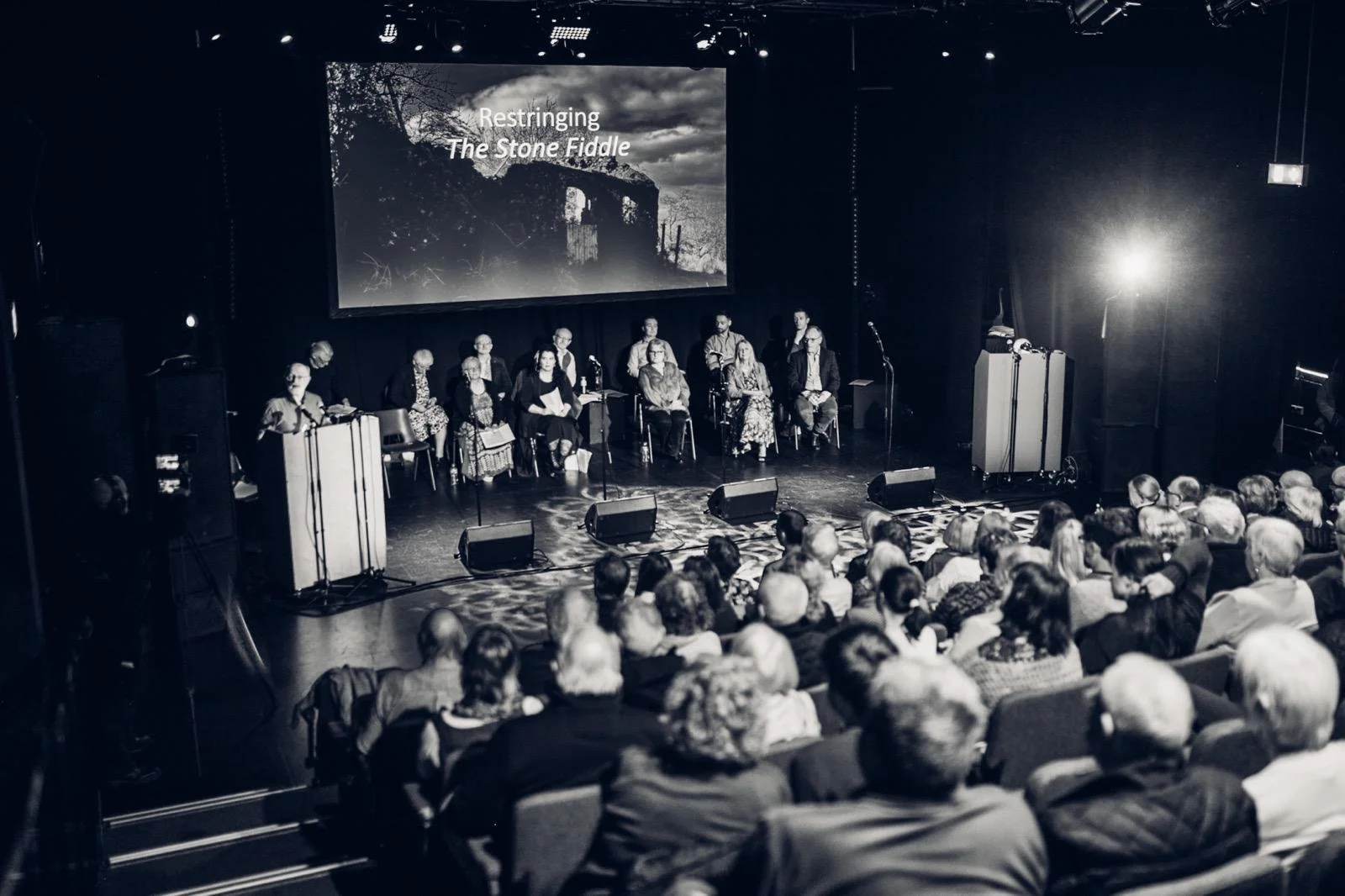
In 2024-2025, as part of the Restringing The Stone Fiddle Project, the Trust staged half a dozen performative readings from The Stone Fiddle. These gigs were the first time that this new generation sang alongside some of the legends of the Irish tradition, the likes of Rita Gallagher, Máiréad Mooney, Lillis Ó Laoire and Gabriel McArdle. It was a great experience for them.
Paddy Óg’s daughters, Maria Tunney and Brigid Gosling (nee Tunney), have voices so alike in tone and timbre, and they sing with such similar attack, that it can be difficult to tell them apart. Both are married and live in the UK and so we don’t hear them nearly as often as we would like. On this recording Brigid gives us Lovely Willie and then the girls sing The Old Man Rocking the Cradle as a duet. Andrew South, Maria’s husband, recorded these performances in London in 2026.
My sister Maura has made a point of singing to her five boys since they were very young and has worked hard to pass on many songs to them. Two of the lads can be heard on this release, Colm and Séamus. Colm was recorded in B-Note Studios in Berne in Switzerland, where he currently lives. He sings As I Roved Out, learned from his mother and, interestingly, she too can be heard singing it on this LP. Séamus and my son Conall know and can each sing as many as a hundred of the family songs. Both were recorded in the ITMA by Iarlaith Mac Gabhann and Maedbh Ó Raghallaigh. Conall sings the ever-popular May Morning Dew, while Séamus performs the evocative Bonnie Tavern Green. They also duet What Brought the Blood, a famous Child ballad also known as Edward.
Dr John Tunney
Where the Linnets Sing 2026, developed by the Tunney Song Tradition Trust with Comhaltas Ceoltóirí Éireann, celebrates 75 Bliain ag Fás by bringing the original collection to a new online audience, enriched with fifteen additional tracks, eleven more voices and two further generations of the tradition.